For early-stage teams without a dedicated recruiting function, fractional recruiter work offers a middle path between a full-time hire you can’t yet support and a contingency agency whose fees scale with every offer. This guide covers how it works, what it costs, and how to decide if it fits your stage.
TLDR:
-
A fractional recruiter works a portion of full-time hours across multiple clients, giving your startup specialist hiring support without a full-time salary.
-
Agency recruiters charge 10-30% of a hired candidate’s first-year salary; fractional engagements bill on an hourly or retainer model, and Dover marketplace hires average about $4,000.
-
You can scale fractional hours up or down as hiring volume changes, paying only during active hiring sprints instead of carrying fixed overhead year-round.
-
Fractional recruiters often specialize by role type, so you can access technical recruiting expertise for in-demand positions like engineers or product managers.
-
Some fractional recruiting services pair recruiters with a shared ATS at no added cost, so your internal team and recruiter work from the same pipeline from day one.
What is a Fractional Recruiter?
The term “fractional recruiting” describes staffing an organization with recruiters who work a portion of full-time hours, often across multiple clients. Unlike agencies or full-time hires, fractional recruiters bring specialist expertise on a flexible, lower-cost basis.
How Fractional Recruiting Differs from Other Hiring Models
-
Fractional vs. Freelance: Freelancers execute discrete, project-based tasks (writing a spec, building a feature). A fractional recruiter fills an ongoing strategic role, owning your hiring process.
-
Fractional vs. Part-Time: A part-time employee works exclusively for one employer on a reduced schedule. A fractional professional splits their week across multiple clients, bringing cross-company pattern recognition that a single-employer hire rarely develops.
-
Fractional vs. Contractor: Contractors are typically scoped to a project with a defined end date. A fractional engagement is an ongoing relationship; the recruiter learns your culture, hiring bar, and pipeline over time instead of exiting when a specific deliverable ships.
What are the Benefits of Hiring a Fractional Recruiter?
| Benefit | What It Means in Practice | Best For |
|---|---|---|
| Affordable | Flat hourly or retainer pricing replaces expensive full-time recruiter salaries or agency contingency fees | Startups with limited runway that still need recruiting expertise |
| Adaptable | Scale hours up or down as hiring volume changes, with no fixed overhead during slow periods | Companies with cyclical or unpredictable hiring needs |
| Bespoke Expertise | Recruiters often specialize in specific roles (e.g., software engineers, product designers) for higher candidate quality | Teams hiring for competitive or technical positions |
| Dedicated Recruiter | An embedded recruiter learns your culture and hiring bar over time, unlike a one-off agency placement | Startups that want a true internal-feeling recruiting partner |
| Better Candidate Quality | Frees internal team members to focus on their core jobs while a specialist screens and sources candidates | Small teams where employees are doubling as ad-hoc recruiters |
| Efficient Scalability | Engage for the duration of a hiring sprint; pause when roles are filled, paying only for what you need | Growth-stage companies with burst hiring followed by quiet periods |
| Objective Advisor | Cross-company experience gives fractional recruiters an outside perspective and the credibility to flag what isn’t working | Founders who want a candid read on their hiring process |
When Fractional Recruiting Works Best
-
Pre-Series A startup hiring its first engineers. A fractional recruiter at 15-20 hours/week delivers structured sourcing and interview coordination without the fixed overhead of a $150K+ salary, then exits cleanly when the sprint is done.
-
Series B/C company with cyclical hiring bursts. Scale up for a product launch push, then pause when the pipeline is full, costs stay tied to actual hiring activity.
-
Mid-size company building a new technical practice. A fractional technical specialist can own a focused search for 3-6 months, then exit once the core team is in place.
Embedded Recruiters vs. Agency Recruiters
|
| Fractional/Embedded Recruiter | Agency Recruiter | Full-Time In-House Recruiter |
| — | — | — | — |
| Cost Structure | Flat hourly or monthly retainer (recruiters set their own rates) | Contingency fee: 10-30% of the hired candidate’s first-year salary | Fixed salary + benefits; fully loaded cost often exceeds $150K/year |
| Time Commitment | Part-time or full-time hours split across clients; typically 5-40 hrs/week as scoped | No time commitment required from the company; agency manages the search independently | 40 hrs/week, dedicated exclusively to your company |
| Integration Level | High: works inside your Slack, ATS, and hiring process; attends syncs as a team member | Low: operates independently; limited visibility into your culture or internal processes | Full: deeply embedded, owns the entire recruiting function |
| Best For | Startups with ongoing but variable hiring needs; teams without a dedicated recruiting function | One-off, urgent hires where speed outweighs cost; roles with very specialized requirements | Companies with continuous, high-volume hiring that warrants a full-time headcount |
| Typical Engagement Length | 6-12 months, or scoped by role; can scale up/down as hiring volume changes | Project-by-project; engagement ends when the role is filled | Indefinite; ongoing employment relationship |
| Payment Terms | Paid on a retainer or hourly basis regardless of hire outcome | Pay only on successful hire; no placement, no fee | Salary paid continuously whether or not active hiring is underway |
| Risk Level | Low-to-medium: costs are predictable; no large single payout; easy to pause | Medium-to-high: one hire at a six-figure salary can trigger a $15K-$40K+ fee | High: fixed overhead continues through slow hiring periods; severance risk if role is eliminated |
Businesses can also use agency recruiting services to find qualified individuals for open positions. Payment is only made when the agency’s recommended candidate is hired. The percentage that a contingency recruiter charges for their services is usually between 10% and 30% of the hired employee’s annual salary. SHRM’s 2025 cost-per-hire benchmarks put the average non-executive hire at $5,475 in baseline recruiting costs, and agency fees push total acquisition costs considerably higher.
There is also the option to hire a full-time in-house recruiter. However, typically early stage startups do not need a salaried recruiter unless they anticipate continuous hiring needs that warrant the expense. The BLS median wage for HR specialists was $72,910 in May 2024, and fully loaded annual costs with benefits and overhead often push the total well above $100,000.
When comparing an embedded recruitment approach to either a pay-per-hire or a full-time recruiter approach, consider the cost, flexibility, and hiring needs when making a decision.
How to Hire a Fractional Recruiter?
If you’re a founder considering fractional hiring, here’s how to get started:
-
Determine your hiring needs: what types of roles (sales, engineering, marketing, analytics, etc.) do you need to hire?
-
Research the current market for technical recruiters or recruiters who are experts at hiring the roles you’re looking to fill. You can use benchmarking tools like Pave to learn how much technical recruiters make. What would they make on an hourly basis? Then make a realistic recruiting budget.
-
Calculate how many weekly hours of recruiting help you’ll need based on how many positions you are hiring for. A standard engagement runs 5, 10, 20, or 40 hours per week.
-
Once you know what you need and your rough budget, search LinkedIn for recruiters with relevant experience or work with a service like Dover to access vetted fractional recruiters.
What Tools Do Fractional Recruiters Use?
Most fractional recruiters operate within whatever tooling the client already uses, but the baseline that determines how smoothly the engagement runs is the applicant tracking system. A shared ATS gives both the recruiter and the internal team visibility into the same pipeline: who has been sourced, where each candidate stands, and what feedback has been logged. Without it, coordination typically defaults to spreadsheets and status emails, which creates overhead that eats into the hours a fractional recruiter is billing.
Beyond the ATS, fractional recruiters commonly use LinkedIn Recruiter or similar sourcing tools, structured interview kits, and whatever communication channels (Slack, email) the client team prefers. Some fractional recruiting services pair recruiters with a purpose-built ATS at no additional cost, so recruiter and hiring manager are working from the same system from day one, which can reduce the setup friction that comes with connecting external contractors to internal hiring infrastructure.
Tips for Startups and Founders
Rank Your Roles: Focus fractional support on in-demand technical positions like Software Engineer, Product Manager, or Product Designer where specialist expertise matters most.
-
Set Clear Goals: Tell your recruiter precisely what results and objectives you expect. Well-defined goals are the foundation of a productive engagement.
-
Integrate Your Team: Make sure internal teams and your fractional recruiter share the same tools and communication channels (email, Slack, and a shared ATS) so nothing falls through the cracks.
-
Review and Revise: Regularly assess your hiring needs and adjust hours as volume changes.
How Dover Fits Into Fractional Recruiting
For startups working through the fractional recruiting decision, the practical question is whether the recruiter you bring in will operate as a true partner inside your process or as an outside vendor making periodic check-ins. The answer depends on how the engagement is structured from the start: whether the recruiter shares your hiring infrastructure or manages their own pipeline separately.
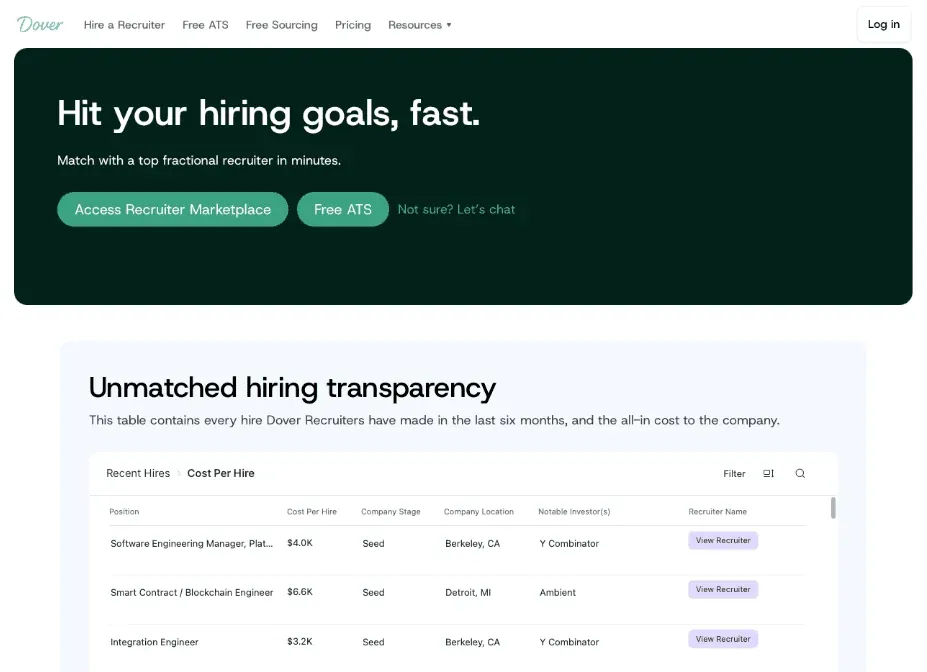
Dover pairs a free applicant tracking system with a marketplace of experienced fractional recruiters who work directly inside your hiring pipeline. Recruiters set their own rates, and total cost per hire averages about $4,000, with most standard searches landing at $2,000-$7,000. There are no long-term contracts; you start with an $800 fully refundable deposit and can pause or stop at any point.
Because the fractional recruiter and your internal team share the same ATS, there is no coordination gap between what the recruiter is doing and what your hiring managers can see. Sourcing activity, candidate status, and pipeline data are visible to everyone in real time. That shared infrastructure is what turns a fractional engagement into something that feels like having an internal recruiting function, without the fixed overhead.
Frequently Asked Questions
What’s the difference between a fractional recruiter and a contingency agency recruiter?
A fractional recruiter bills for time worked (hourly or on retainer) and works inside your hiring process as a dedicated partner, while a contingency agency recruiter charges 10-30% of the hired candidate’s first-year salary only when a placement is made. That fee structure pushes agencies toward speed over fit, whereas a fractional engagement ties the recruiter’s time directly to your search quality.
Should I use a fractional recruiter or hire a full-time in-house recruiter for my Series A startup?
A full-time recruiter makes sense when you anticipate continuous, high-volume hiring that warrants a loaded annual cost often exceeding $150K, and most Series A companies aren’t there yet. A fractional engagement at 15-20 hours per week gives you structured sourcing and interview coordination without fixed overhead, and the engagement ends cleanly once a hiring sprint is complete.
What types of roles benefit most from fractional recruiting?
In-demand technical and specialized roles, such as software engineers, product managers, and product designers, tend to benefit most, since finding strong candidates requires sourcing expertise and domain knowledge that most founding teams don’t have in-house. Entry-level positions with straightforward requirements and deep applicant pools (SDRs, customer support) are generally easier to manage without dedicated recruiting support.
Final Thoughts on Fractional Recruiting for Startups
Fractional recruiter work gives early-stage teams a real alternative to the false choice between expensive in-house headcount and contingency agency fees. The model ties recruiter time directly to your search priorities, scales with your hiring volume, and ends cleanly when a sprint is complete. Dover pairs a free ATS with experienced fractional recruiters, hires averaging about $4,000, no long-term contracts, and no placement fees, making it one of the most straightforward ways to get started.
Work with one of Dover’s Hiring Experts!
If demand keeps rising, CEOs, founders, and entrepreneurs should discover the power of fractional hiring.
Startups are revolutionized by fractional recruiting. In a highly competitive industry where salaries are rising, you can take advantage of expert talent without going into debt.
Dover is an excellent option for expanding your startup through fractional recruitment.
As a team, we understand the struggles startups face needing to prioritize building great products and tools over hiring new employees.
Take advantage of our on-demand recruiting services to quickly and affordably fill open positions with top talent, allowing your business to expand rapidly!