
Time-to-Hire vs Time-to-Fill: The Ultimate Guide for June 2026

Dover
•
3 mins


Time-to-hire measures the duration from when a candidate first applies or enters your recruitment pipeline until they accept your job offer. This metric focuses on the candidate's experience moving through your hiring process.
Think of it as the candidate's journey timeline. It starts ticking the moment someone submits their application and stops when they say "yes" to your offer. This differs from measuring how long a position stays open. Time-to-hire zeroes in on individual candidate progression, making it important for understanding how well your process works. As you probably know, the best engineers and product managers get snapped up quickly in today's market which means that you may lose top candidates if your time-to-hire drags on too long.
Time-to-fill takes a much broader view of your hiring timeline than time-to hire does. It measures the complete recruitment cycle from the moment you get approval for a new position until someone accepts your offer and starts working.
This metric captures everything: internal approvals, budget sign-offs, writing job descriptions, posting roles, sourcing candidates, interviewing, and final negotiations. Time to fill gives you the organizational perspective on how long it actually takes to get a seat filled.
The biggest mistake startups make is treating these metrics as interchangeable when they measure completely different aspects of your hiring process. Understanding the distinction can help you diagnose exactly where your recruitment process breaks down. There are three core differences:
Starting Points: Time-to-hire begins when a candidate applies or enters your pipeline. Time-to-fill starts much earlier, when you first identify the need for a new role or get budget approval.
Scope: Time-to-hire only covers the candidate's journey through your process while time-to-fill includes everything from internal planning to the new hire's first day.
Purpose: Time-to-hire reveals candidate experience and how well your process works where time-to-fill shows organizational readiness and total business impact.
Time-to-Hire | Time-to-Fill | |
|---|---|---|
Measures | Candidate journey from application to offer acceptance | Full hiring cycle from job approval to start date |
Starts when | Candidate applies or enters pipeline | Job requisition is approved |
Ends when | Candidate accepts the offer | New hire starts the role |
Reveals | Interview process quality and candidate experience gaps | Internal planning delays and organizational readiness |
Best used for | Optimizing how candidates move through your process | Improving resource allocation and headcount planning |
Although these metrics are different, they both matter. Use time-to-hire to optimize your interview process and candidate experience and time-to-fill to improve organizational planning and resource allocation.
How to Calculate Time-to-Hire and Time-to-Fill
Calculating these metrics manually can be a nightmare for startups, but the time-to-hire formula is actually straightforward once you know what data to capture. You just need to be consistent about recording the right dates.
Time-to-Hire Formula: Time-to-Hire = Offer Acceptance Date - Application Date
Time-to-Fill Formula: Time-to-Fill = Start Date - Job Requisition Approval Date
Consider the following example:
Sarah applies for your product manager role on January 5th
She accepts the offer on January 28th
Her time-to-hire then is 23 days
But in that example, budget approval for the new product manager role was actually received on December 15th. That means that the time-to-fill is actually 44 days.
An Application Tracking System (ATS) automatically calculates both metrics for every candidate, giving you average times by role, department, or hiring manager without manual tracking.
Industry Benchmarks for Time-to-Hire in 2026
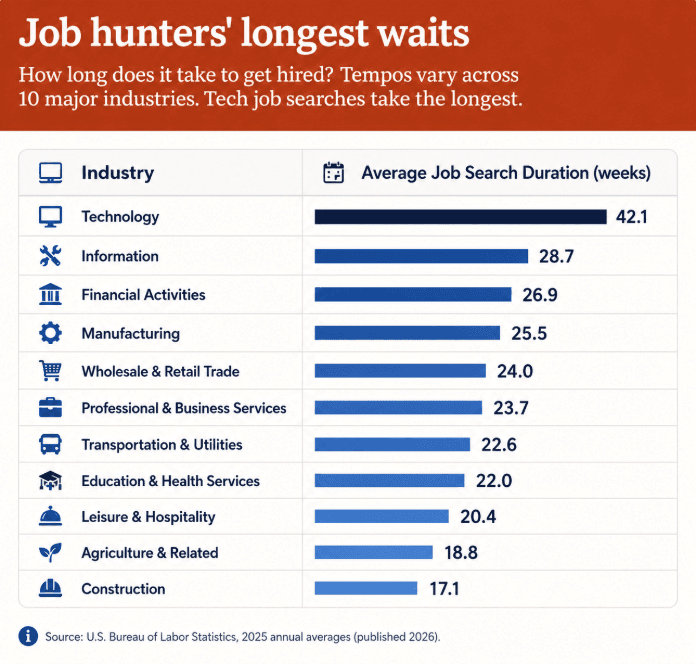
Hiring timelines remain elevated in 2026 as companies move more cautiously on hiring decisions and competition for skilled talent continues to intensify. According to recent labor market survey data, the average job search now lasts roughly 6.6 months, with technology candidates facing the longest hiring cycles by a significant margin.
Examples of Average Hiring and Job Search Timelines by Industry (2026):
Technology: 42–50+ days average time-to-hire, with overall job searches averaging 9.7 months
Healthcare: 36–44 days, with lower application volume and shorter search timelines than most industries
Finance: 40–48 days due to multi-stage interviews and compliance-heavy hiring processes
Manufacturing: 30–38 days, remaining one of the faster sectors for hiring and placement
Retail and Hospitality: 18–28 days, with some of the shortest hiring cycles overall
Recent 2026 survey data also shows that job seekers now submit an average of 62.6 applications before landing a role, while technology candidates average more than 100 applications during their search. Resources like SHRM and the U.S. Bureau of Labor Statistics continue to track hiring and recruiting benchmark trends across industries.
A Closer Look: Technology Startup Time-to-Hire
Tech roles, especially in startups, take the longest to hire because companies are being pickier about technical skills and cultural fit. According to Workable, technology roles, like development and engineering, often take an average of 33 days to hire. But time-to-hire in tech startups is also impacted by the competitiveness for top talent. The higher average length of time-to-hire probably reflects the complexity of finding candidates who match both technical requirements and startup culture.
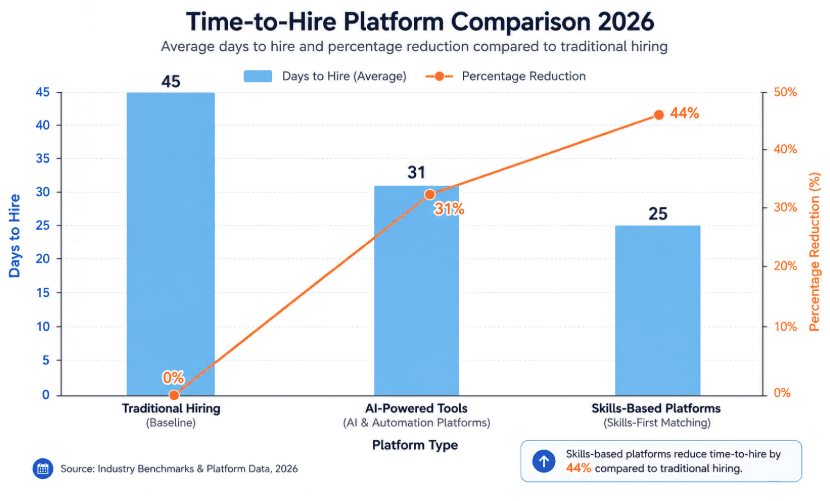
The thorough vetting makes sense, but it can cost you talent. Industry data shows that startups using structured processes and pre-screening tools cut their tech hiring time by an average of 12 days.
Don't Just Optimize For Speed, Optimize For Cost Too
Average Cost-Per-Hire by Industry 2026
How to Improve Time-to-Hire
Using Technology to Speed Up Hiring
Frequently Asked Questions
Final Thoughts on Optimizing Your Hiring Metrics
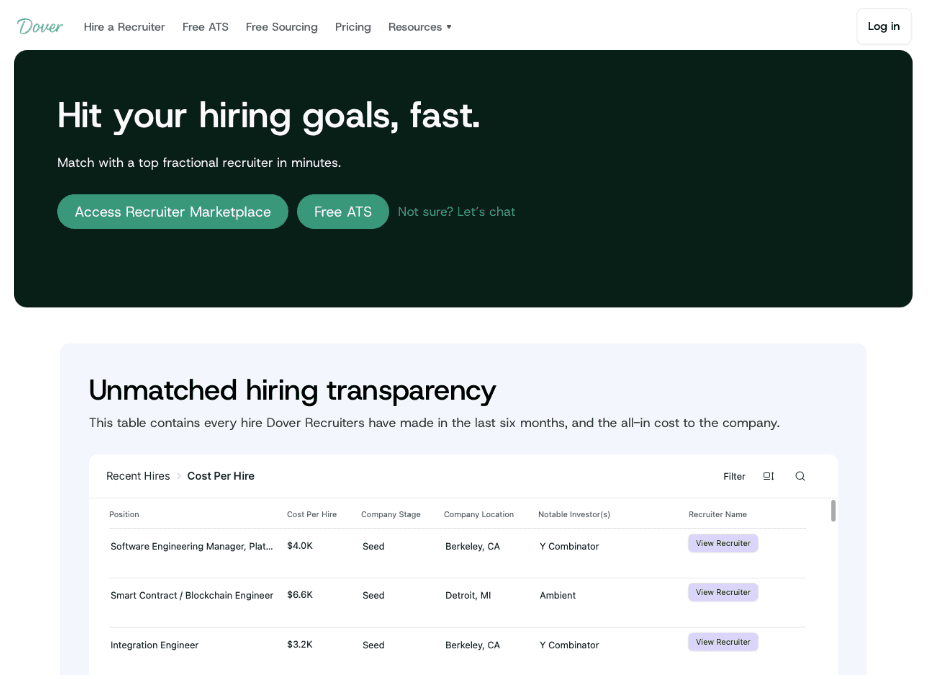
Understanding the difference between time-to-hire and time to fill gives you the complete picture of where your recruitment process breaks down. Most startups find that their biggest delays aren't in interviews but in internal approvals and candidate sourcing. Tracking both metrics helps you optimize recruiting performance at every stage, from initial job approval to final offer acceptance, and helps bring down the cost of hiring the best candidates. Tools like Dover make it easier to act on these metrics and move fast on great candidates.
Table of contents
Kickstart recruiting with Dover's Recruiting Partners
