
Most startups underestimate the true price of a new hire. Your team’s time spent on hiring, failed replacements, and lost momentum often push the total far beyond the initial estimate. While great recruiter services optimize hiring and save you time, the wrong ones can quietly double your costs. Let’s break down what you should really expect to pay in 2026, and how to make smarter choices.
TLDR:
-
Tech recruiter fees range from 15-30% of salary, but fractional recruiting saves 50-70% on costs
-
A $120k engineer costs $24k through agencies vs under half that amount with fractional recruiters
-
Hidden costs like failed hires and internal time can double your true recruiting expenses
-
Fractional recruiting works best for startups hiring 3+ people annually with budget constraints
-
Some platforms act as the infrastructure layer fractional recruiting agencies are built on, with vetted recruiter reviews and no percentage-based fees
Tech Recruiter Fee Models Breakdown
Let’s break down the three main pricing models you’ll encounter when hiring external recruiting help.
-
Percentage-based fees are the most common model: industry analysis puts typical tech recruiter fees at 15-30% of the candidate’s first-year salary. For a software engineer making $120,000, you’re looking at $18,000 to $36,000 in recruiting fees. That’s a big chunk of change, especially when you’re hiring multiple people.
-
Flat fee models typically run $5,000 to $20,000 per hire, regardless of salary. This can be more predictable for budgeting, but you might overpay for junior roles or underpay for senior positions. Some agencies use flat fees for high-volume hiring or specific role types.
-
Hourly or fractional recruiting charges $75-250 per hour depending on the recruiter’s experience and specialization. A typical hire might take 40-80 hours of work, putting your total cost between $3,000 and $20,000. The beauty here is transparency: you pay for actual work done, not arbitrary percentages.
-
That $120K software engineer could cost you $24,000 through a traditional agency (20% fee) or potentially $8,000 through fractional recruiting (50 hours at $160/hour). When you’re hiring multiple people, these savings compound quickly.
The fractional model also gives you more flexibility. Need help with sourcing but want to handle interviews yourself? Pay for sourcing hours only. Want full-service recruiting for one role and just candidate screening for another? Mix and match based on your needs.
Real World Cost Examples for Tech Roles
Let’s get specific with some real numbers that reflect what startups actually pay in 2026.
Software Engineer ($120k salary):
-
Traditional agency (20%): $24,000
-
Fractional recruiter (50 hours at $150/hour): $7,500
-
Savings: $16,500 per hire
Senior DevOps Engineer ($140k salary):
-
Traditional agency (25%): $35,000
-
Fractional recruiter (60 hours at $180/hour): $10,800
-
Savings: $24,200 per hire
Engineering Manager ($160k salary):
-
Traditional agency (25%): $40,000
-
Fractional recruiter (70 hours at $200/hour): $14,000
-
Savings: $26,000 per hire
Now imagine you’re a Series A startup hiring five engineers in six months. Traditional agencies would cost you $120,000+ in fees alone. Fractional recruiting might run $40,000-60,000 for the same hires. That’s $60,000+ back in your budget.
| Role | Salary | Agency Fee (20%) | Fractional Cost | Savings |
|---|---|---|---|---|
| Frontend Engineer | $115K | $23,000 | $7,500 | $15,500 |
| Backend Engineer | $125K | $25,000 | $8,000 | $17,000 |
| DevOps Engineer | $140K | $28,000 | $10,800 | $17,200 |
| Total (3 hires) | $380K | $76,000 | $26,300 | $49,700 |
We’ve seen startups save exactly these amounts by switching from traditional agencies to fractional recruiting. The key is finding recruiters who specialize in your specific tech stack and understand efficient talent hiring.
Comparing Recruiting Costs: Agency vs. In-House vs. Fractional
In-house recruiting averages about 12% of each hire’s salary when you factor in recruiter salaries, benefits, tools, and overhead. A full-time tech recruiter costs $80,000-120,000 annually, plus another $20,000-30,000 in benefits and tools. They might make 8-12 hires per year, putting your cost per hire around $8,000-15,000.
The challenge? You need consistent hiring volume to make a full-time recruiter worthwhile. If you’re only hiring 2-3 people per year, you’re paying for a lot of downtime.
-
Traditional agencies cost 15-30% per hire but require zero ongoing commitment. They handle everything from sourcing to offer negotiation, which is appealing when you’re swamped. The downside is losing control over candidate experience and paying premium rates for every single hire.
-
Fractional recruiting sits in the sweet spot between agency expertise and in-house control. You get experienced recruiters with complete transparency into their work. No long-term commitments, no percentage fees, just pay for results.
We’ve found that fractional recruiting works particularly well for startups in growth mode. You get the expertise of senior recruiters without the overhead of full-time staff or the markup of traditional agencies.
The math usually works out like this: if you’re hiring fewer than 6 people per year, fractional beats in-house. If you’re hiring more than 3 people per year, fractional beats traditional agencies. There’s a reason more startups are making this switch.
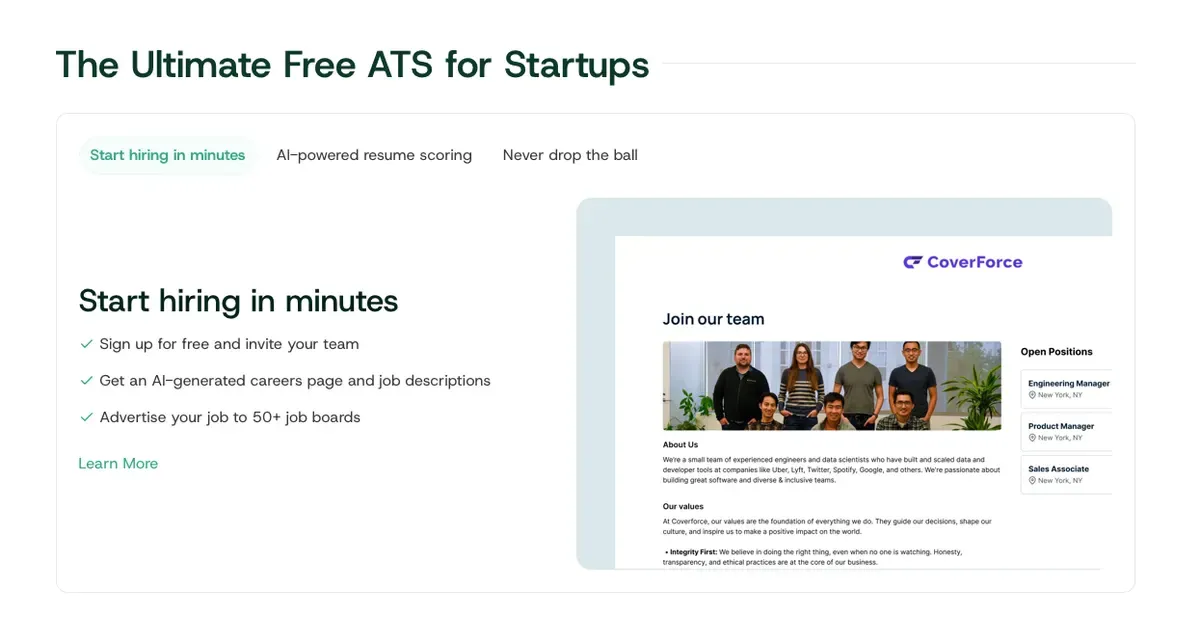
Fractional recruiting also performs best when your recruiter and internal team share a live view of the candidate pipeline. Without a common applicant tracking system, coordination typically happens through email threads, spreadsheet updates, and manual handoffs - each one adding friction and increasing the chance of candidates slipping through the cracks. A shared ATS removes that overhead: the recruiter sources and screens inside the same system your hiring managers use, with full pipeline visibility on both sides from day one. This is the infrastructure layer that fractional recruiting agencies run on when operating inside a system like Dover. All candidate data, sourcing history, and pipeline activity stays in the client’s system, not the recruiter’s, so each new search builds on prior work instead of starting cold.
Hidden Costs in Tech Recruiting
The sticker price is just the beginning. Hidden costs can easily double your true cost per hire, making seemingly expensive recruiting solutions actually cost-effective.
-
Internal time costs are massive but often ignored. Every interview round pulls your engineers, managers, and founders away from building product (and engineers are often the highest paid in the company). A typical hiring process involves 6-8 internal people spending 2-4 hours each on interviews, reference checks, and decision-making. At $100+ per hour for technical staff, the hidden cost of hiring adds up to $1,200-3,200 per hire in lost productivity alone.
-
Failed hire replacement costs are brutal. According to current research on the cost of a bad hire, the U.S. Department of Labor estimates a bad hire costs at least 30% of that employee’s first-year earnings, and industry data puts the first-year failure rate for new hires at roughly 1 in 5. When a $120k engineer leaves after six months, you’ve lost their salary, benefits, onboarding time, and recruiting fees. Then you get to pay all those costs again for their replacement.
-
Time-to-fill impacts compound quickly in competitive markets. Every extra week an engineering position stays open is lost product development, delayed features, and increased pressure on existing team members. For a senior role, this opportunity cost can exceed $10,000 per month.
-
Opportunity costs of unfilled positions are hardest to quantify but potentially most expensive. That missing DevOps engineer might delay your product launch by two months. The frontend developer you can’t find might force you to push back a major client deliverable.
This is where candidate experience becomes important. A smooth, professional hiring process reduces the risk of losing great candidates to competitors and improves your employer brand for future hires.
When Different Fee Structures Make Sense
Not every recruiting situation calls for the same approach. Here’s when each fee structure typically makes the most sense.
Contingency fees work best for single, urgent hires where speed trumps cost. If you need a CTO in 30 days and budget isn’t the primary concern, paying 25-30% for agency speed and network access makes sense. The agency takes all the risk and you only pay for results.
Flat fees suit high-volume, similar roles where you can negotiate better rates. If you’re hiring 10 junior developers with identical requirements, a flat fee structure gives you predictable costs and potentially better per-hire rates than percentage fees.
Fractional or hourly recruiting works best for ongoing hiring needs, multiple different roles, or when budget predictability matters. It’s particularly effective when you want to maintain control over the candidate experience while getting expert recruiting help.
Retained search makes sense for executive roles where the search process is complex and relationship-driven. C-level positions often require 3-6 months of dedicated work, making upfront payment structures more appropriate.
The key is matching your specific situation to the most cost-effective approach. A Series A startup hiring their first 10 engineers has very different needs than a Series C company replacing a departing VP of Engineering.
We’ve found that most growing startups benefit from choosing the right recruiter who can adapt their approach to different roles and timelines instead of being locked into a single fee structure.
How to Decide the Best Recruiting Approach for Your Startup
Hiring volume is your biggest decision factor. If you’re hiring 1-2 people per year, traditional agencies or fractional recruiting make more sense than building internal capacity. If you’re hiring 3-6 people per year, fractional recruiting typically offers the best cost-effectiveness. Above 6 hires annually, consider building an internal recruiting function.
Budget constraints matter more for startups than mature companies. If cash flow is tight, hourly fractional recruiting gives you more control over spending than large percentage fees. You can scale recruiting effort up or down based on your current funding situation.
Timeline requirements influence your options. Need someone in two weeks? You’ll probably pay premium agency rates. Have 2-3 months to fill a role? Fractional recruiting can deliver better candidates at lower costs.
Internal capacity determines how much recruiting work you can handle yourself. If your founding team is already working 80-hour weeks, full-service recruiting makes sense. If you have bandwidth for interviews but need help with sourcing, fractional recruiting lets you pay for just the pieces you need.
Role complexity affects your approach. Standard software engineering roles are easier to recruit for than highly specialized positions requiring specific industry experience. Complex roles might warrant higher fees for recruiters with proven track records in your niche.
For most tech startups, fractional recruiting hits the sweet spot. You get access to experienced recruiters who understand your market, transparent hourly pricing that scales with your needs, and the flexibility to adjust your recruiting investment based on growth stage and funding.
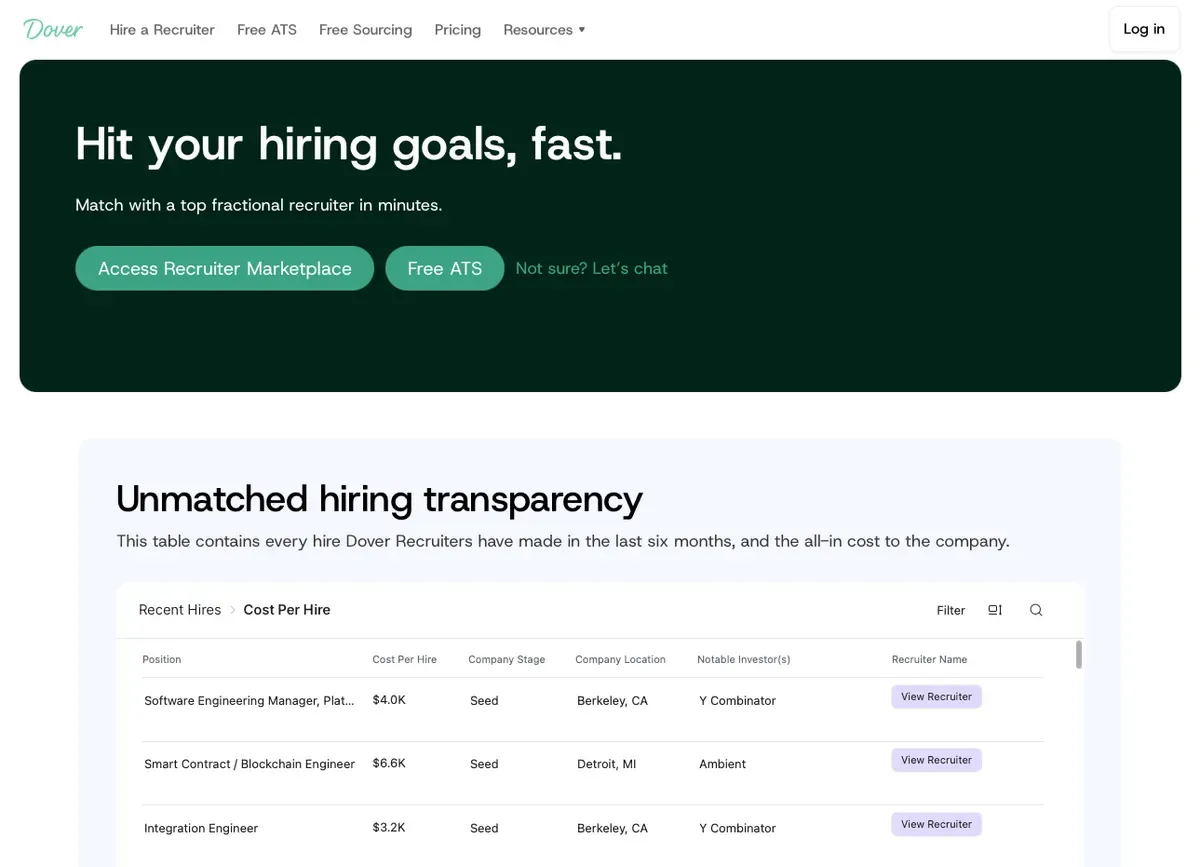
Dover is the system fractional recruiting agencies are built on. It connects startups with vetted tech recruiters who carry real, published reviews, charging by the hour instead of taking a percentage of salary. For teams that need professional recruiting help without long-term commitments or opaque fees, that combination of verified recruiter quality and hourly pricing tends to be the most cost-predictable path.
How AI Tools Are Changing Tech Recruiting Costs in 2026
AI-assisted sourcing and screening tools have shifted the math on recruiting spend in a few concrete ways. Many fractional recruiters now use AI to handle initial candidate sourcing and resume screening, which compresses the hours billed per hire. A role that previously required 60 hours of recruiter time may now take 40-50 hours when AI sourcing tools handle the top-of-funnel work. On Dover, that reduction shows up directly in your cost. Because you pay by the hour, not a flat percentage, every time saving passes through to you.
For startups using traditional agencies, the fee structure hasn’t changed. You’re still paying 15-30% of salary regardless of how much automation the agency uses internally. That’s one reason the gap between fractional and agency costs has widened in practice, even if the published fee ranges look similar to prior years.
AI screening tools also affect your internal time costs. Automated interview scheduling and async video screening can cut the coordination load on your engineering team, reducing the hours typically spent per candidate before a final round. Dover’s ATS has automated scheduling built in, so the same system your fractional recruiter works from handles the internal coordination overhead without adding another tool.
The practical implication: when comparing fractional recruiters in 2026, ask which AI sourcing and screening tools they use and whether that’s reflected in their hour estimates per hire. Dover publishes real performance data and verified reviews for every recruiter in the marketplace, so you can check actual hours per hire before you engage instead of finding out after the search closes.
FAQs
How Much Should I Budget for Tech Recruiter Fees in 2026?
Budget 15-30% of first-year salary for traditional agencies, or $75-250 per hour for fractional recruiters (typically 40-80 hours per hire). For a $120k software engineer, expect $18k-36k through agencies versus $3k-20k through fractional recruiting.
What’s the Difference Between Contingency and Fractional Recruiting Fees?
Contingency agencies charge a percentage (15-30%) of the hire’s salary only when successful, while fractional recruiters charge hourly rates or based on actual work performed. Fractional typically costs 50-70% less and gives you more control over the process.
When Does It Make Sense to Use Expensive Agency Recruiting?
Use traditional agencies for urgent, single hires where speed is critical and budget isn’t the primary concern, or for executive-level searches requiring extensive networks and relationship-building. If you need a CTO in 30 days, the premium may be worth it.
How Do I Calculate the True Cost of a Recruiting Hire?
Add the recruiting fee plus internal time costs (6-8 people spending 2-4 hours each at $100+/hour), potential replacement costs if the hire fails (20-30% failure rate), and opportunity costs of unfilled positions. This often doubles the apparent recruiting cost.
Final Thoughts on Tech Recruiting Costs
The recruiting math changes when you look beyond surface-level fees and factor in all the hidden costs covered here. Fractional recruiting can deliver the expertise growing teams need without the traditional markup, especially when hiring multiple roles throughout the year. The model works best when the recruiter and internal team share a live pipeline view, keeping sourcing activity and candidate status visible to both sides without manual coordination overhead. Dover is one implementation worth considering: a free ATS paired with experienced tech recruiters who set their own rates, with total costs typically running $2,000 to $7,000 per hire (about $4,000 on average) and no long-term contracts required.