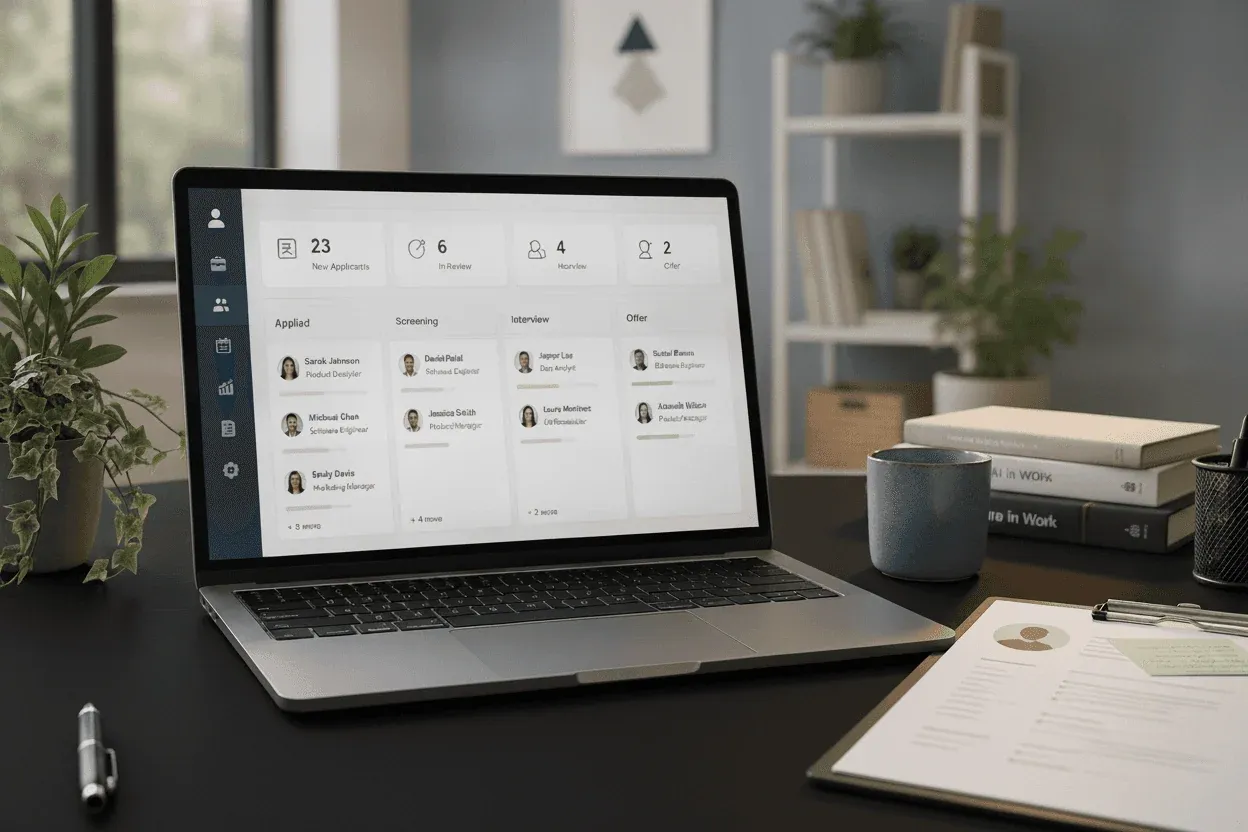
Most early-stage teams track candidates in a spreadsheet and stitch together scheduling tools until hiring volume forces a real decision: invest in a proper recruiting tool or keep patching the workaround. That choice comes sooner than most founders expect, and the options tend to be either expensive or built for dedicated recruiting teams that most startups don’t have yet.
TLDR:
-
Most ATS tools cost thousands per year and require recruiting expertise to run, leaving early-stage teams patching spreadsheets instead.
-
AI resume scoring can help you work through high-volume inboxes without missing strong candidates, when paired with clear hiring criteria.
-
Setup takes under five minutes with no developer help, and postings go to over 100 boards with all applicants landing in one place.
-
An ATS covers the coordination layer; active sourcing into passive talent pools and senior searches may still require a recruiter layered on top.
What Is an Applicant Tracking System?
An Applicant Tracking System (commonly referred to as an ATS) is software used to manage the end-to-end recruitment process, including tracking candidates across roles and interview stages.
Most ATS’s support you in posting jobs to your careers page and other job boards, scheduling candidates, and storing candidate notes and feedback.
Recruiting at it’s core is a matter of process. ATS’s provide structure to the chaos. But there are a few major issues:
-
Most Applicant Tracking Systems are hard to use. The ATS is supposed to be the source of truth for hiring activities… but most companies don’t use them to their full potential. Many ATS’s require complex configuration at the start and in-depth knowledge of recruiting to operate. They require hours of manual overhead to keep candidate and job data up-to-date with each update in the hiring process. Team members outside of Talent Acquisition struggle to use their ATS, which exacerbates the issue.
-
Most Applicant Tracking Systems are costly. Applicant Tracking Systems can cost thousands per year, according to published ATS pricing benchmarks. Startups have always done what they can to defer buying an ATS altogether. They hack together tools like Notion, Google Sheets, Calendly, and Airtable to spin up a careers page, track candidates, schedule them, and store interview feedback. They’re okay with sacrificing time to get a process stood up, even if it takes some additional effort. That’s nothing new. But in a time when hiring plans and recruitment budgets have been scaled back across the board, an expensive ATS expense is unjustified for most startups.
We Built Dover’s ATS for Startups. It’s Easy-to-Use and Free
What are the best parts?
-
Much more friendly interface for hiring managers and interviewers (e.g. non-recruiters). It makes the whole team more involved in hiring and actually enjoy it
-
All-in-one platform (built-in sourcing, scheduling, careers page, and application review), so there’s no need to buy a ton of different tools and figure out how to integrate them
-
Sophisticated workflow automation (e.g. personalized email templates for every stage of the interview process) saves team a ton of time on recruiting operations
Why Our ATS Is Free
Recruiting is broken for candidates and companies. Dover’s mission is to help every company run an incredible hiring process and every candidate have a great experience.
We built an easy-to-use ATS to help every company get the basics right. For companies between 1 and 250 employees, our Applicant Tracking System has everything needed to build a world-class recruiting process and candidate experience.
We don’t believe in charging for basic recruiting tools so it’s free for companies to use. Dover is the ATS layer that fractional recruiting agencies are built on. When an agency from Dover’s marketplace works a search, they run it inside the same system your team uses, with full pipeline visibility, shared candidate data, and no separate tool to reconcile. That architecture is how Dover generates revenue: by connecting companies to vetted fractional recruiting agencies through the marketplace, each with real, verified client reviews from other companies they’ve hired for, and by selling Sourcing Autopilot for teams that want automated outbound sourcing.
What’s Different About Dover’s ATS
After working with 1,500+ companies of all sizes, across all types of roles, we know what good hiring looks like. We’ve codified our learnings into an ATS that sets you up for success.
Most ATSs are designed for recruiters who have time to configure every little detail and can spend 10+ hours a week keeping their ATS up to date.
Dover’s ATS is designed with founders and team members in mind, so you can get started quickly and spend <1 hour a week tracking candidates, even if you’re not a recruiting expert.
| Feature | Dover ATS | Traditional ATS | Spreadsheet Setup |
|---|---|---|---|
| Cost | Free tier | $15 to $500+/month | Free (but time-intensive) |
| Setup time | Under 5 minutes | Days to weeks | Hours |
| Job board distribution | 100+ boards | Varies by plan | Manual posting only |
| AI resume scoring | Yes | Rarely included | No |
| Limits on jobs or users | None | Often tiered | None |
| AI assistant (MCP) integration | Yes | No | No |
| On-demand recruiter access | Yes (hourly, averaging $75-$125/hr) | Not included | Not included |
A few features that are unique to Dover:
-
AI-powered applicant sorting (premium): On the premium tier, Dover automatically sorts applicants from all sources based on your hiring criteria. Review matching resumes 10x faster without the overhead of standalone candidate screening tools, and still avoid missing strong candidates.
-
Create a careers page and post to LinkedIn for free: Create a customized careers page. Post unlimited jobs on LinkedIn for free through our partnership.
-
Quick review page: See every candidate you need to act on in one place. Move candidates forward or send a polite rejection with just one click.
-
AI assistant integration: Dover’s MCP integration connects your ATS to AI assistants like Claude, ChatGPT, and Codex so you can review applicants, schedule interviews, add notes, and update pipeline stages directly through your AI assistant of choice.
Why You Shouldn’t Use Dover’s ATS
-
If you work for an agency. Dover’s ATS was built for in-house teams running recruiting for one company at a time.
-
If you’re accepting applications that aren’t in English. At this time, Dover only supports parsing of English resumes.
-
If you don’t use Google Workspace for Email/Calendar or Microsoft Outlook. You CAN still use the ATS, but won’t be able to connect your calendar and send emails through the platform. If that’s important to you, it won’t be a great fit. Also, you need to have domain that’s not a personal domain.
For searches that do need more recruiting support, Dover’s marketplace connects you to vetted fractional recruiters with real, verified client reviews from other companies they’ve hired for. They work inside the same pipeline as your internal team, so there’s no coordination gap between what the agency is doing and what your hiring managers can see.
Startup Hiring in 2026: What’s Changed
Two things have shifted noticeably for startup hiring teams since this ATS launched. First, AI assistants have become a daily workflow tool for many founders and engineers. Dover’s MCP integration now connects the ATS directly to Claude, ChatGPT, and Codex, so reviewing applicants, updating pipeline stages, and scheduling interviews can happen inside the AI assistant your team already uses instead of context-switching to a separate tab.

Second, recruiting budgets at early-stage companies have tightened further. Startups that had grown accustomed to spending on sourcing tools, scheduling software, and separate ATS licenses are pulling back, and free tooling with genuine functionality (not a freemium trial with key features locked) has become the default starting point instead of an exception. Dover’s ATS was built for exactly that posture: the core recruiting workflow is free, you upgrade to the $199/month premium tier only when you want the AI layer, and you add fractional recruiting only for the roles where you actually need it.
How Dover’s Free ATS Works

Dover’s ATS is built for companies between 1 and 250 employees that need to run a structured hiring process. The core workflow, which includes a careers page, job posting, applicant tracking, CRM, scheduling, and email templates, is free with no limits on jobs or users. AI applicant scoring and AI note taking sit on the $199/month premium tier. Setup takes under five minutes, with no developer help or complex configuration required.
A few things stand out about how the product is built. Job postings go out to over 100 boards, including LinkedIn, with all applicants landing in one central place. For teams that already use AI assistants like Claude or ChatGPT, Dover’s MCP integration connects your ATS directly to those tools so you can review applicants, update stages, and schedule interviews without switching tabs.
The free tier is not a limited trial. You can access Dover’s ATS for free. If you need more features like unlimited LinkedIn Posts, AI Applicant Scoring, Bulk actions, and more, you can upgrade to the premium tier. If a search turns out to need more hands-on recruiting work, you can bring on fractional recruiters, with most roles averaging $2,000 to $7,000 per hire, near the SHRM 2025 cost-per-hire average for non-executive roles. The ATS stays free regardless of whether you need recruiting help.
An ATS covers the coordination layer: tracking where candidates stand, keeping communication consistent, and collecting feedback in one place. Where it stops is active sourcing into passive talent pools, stakeholder management on senior searches, or a search that has stalled because the pipeline is thin. When a role reaches that point, a fractional recruiting agency can plug into the same system and work the pipeline without any re-setup or handoff overhead.
FAQs
How long does it take to set up Dover’s ATS?
Setup takes under 5 minutes. You can create a branded careers page, configure your first job posting, and connect your calendar without any developer help or complex configuration. Most teams post their first role within the same session.
Which job boards does Dover distribute to?
Dover distributes postings to over 100 boards, including LinkedIn and Indeed. All applicants from every source land in one central place inside the ATS, so you’re not tracking multiple inboxes or spreadsheets.
What is the difference between Dover’s free ATS and the premium plan?
The core recruiting workflow, which covers a careers page, job posting, applicant tracking, scheduling, and email templates, is free with no limits on jobs or users. The $199/month premium plan adds AI applicant scoring, the AI Interview Notetaker for video interview transcription, unlimited free LinkedIn and X job posts, bulk actions, and advanced scheduling. You can start on the free plan and add the premium tier only when you need those extras.
Final Thoughts on Choosing an ATS for Your Startup
Choosing a recruiting tool at an early stage is less about finding the most feature-rich system and more about removing the friction that causes good candidates to fall through the cracks. Most teams need a structured way to track where each candidate stands, a clear path to move them forward, and a way to collect feedback without another Slack message. Dover’s ATS covers that ground for free, and it’s the system that fractional recruiting agencies in Dover’s marketplace are built on. When a search needs more dedicated recruiting work, you can bring in an agency on hourly billing — rates average $75-$125, depending on recruiter and role — with most roles averaging $2,000 to $7,000 per hire. Each agency carries real, verified client reviews, and they work inside the same pipeline as your internal team with no handoff overhead. The right choice depends on your hiring volume and how much of the process you want to own directly.